
'If the Chinese military gets hold of some western sectors on the India-China boundary, it will give them added military advantage.'

The increase in violence along the Line of Control in the last few weeks indicates that despite the olive branch offered by Pakistan Prime Minister Nawaz Sharif, hard-line elements in Islamabad are in no mood to become friendly with India.
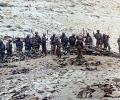
In fact, given the current tensions and massed troops on both sides, there is a danger that the LAC will become more like the Line of Control with Pakistan, a heavily fortified and strongly defended border where weapon fire exchanges regularly occur. Indeed, Stratfor Worldview research has listed a sharp increase in new Chinese facilities along the LAC in 2019-20.

The prime minister said that India has invited Germany to take advantage of opportunities in defence production in the defence corridors in Uttar Pradesh and Tamil Nadu.

The technology is based on the concept of 'cognitive digital radio' that enables users to turn their smartphones into peer-to-peer, off-grid communication tools.

'Our grandparents' generation knew one another.' 'In our generation, you could go a lifetime without meeting someone from the other country,' British Pakistani novelist Kamila Shamsie tells Rahul Jacob.

Until Delhi and Beijing resolve outstanding border issues within an accelerated time frame, standoffs like Doklam will be repeated across various peaks along the Himalayas, says Mathew Maavak.

French President Francois Hollande indicated on Sunday that the nearly Rs 60,000 crore Rafale jets deal is unlikely to be signed during his current visit although it is on the "right track".
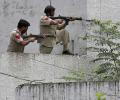
'The target for all our counter-terror operations ought to be Pakistani Punjab's population,' argues Colonel Anil A Athale (retd).

China continues to hold out on fingering Pakistan as the 'mothership of terror,' declaring Masood Azhar a terrorist at the UN, and India's membership of the NSG, says China expert Srikanth Kondapalli.

The attacks on Karachi airport and the Airport Security Force camp are growing signs how Pakistan's home-made monster, the Tehreek-e-Taliban Pakistan, is growing stronger and is no longer under the tight grip of the Inter-Services-Intelligence, its godfather. Vicky Nanjappa reports how these attacks are just the beginning and there are many more to come.

The bravado of NDA ministers may have undone the gains made in cross-border security cooperation over the past several years.
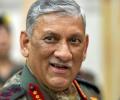
Army chief says Assam's AIUDF has grown at a faster pace than the BJP.
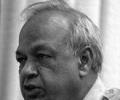
Stephen P Cohen pays tribute to strategic expert B Raman, who passed away recently.

'Why has the rhetoric gone down on the Indian side, Durrani wondered aloud.' 'I said because almost total normalcy and peace had returned on the ground in Kashmir,' recalls Shekhar Gupta. 'The general gave me that career spook's laser look. And he said: "That situation on the ground can change in no time".' 'This was precisely when the Pakistanis began their first incursions into Kargil.' 'Durrani had been retired for five years.' 'But once the ISI boss, you are always in the know.'
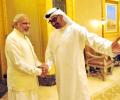
Apart from key bilateral issues, the two leaders also discussed situation in the region, particularly in wake of the increasing threat of terrorism and extremism from various sources including the Islamic State militant group.

'Why can't a person who has supervised military intelligence head RA&W?' 'Why can't one who has overseen national security planning become our NSA or chair the National Security Advisory Board?' asks Vice Admiral Premvir Das (retd).
The Indian Army and more recently the Indian Navy have already set up dedicated intelligence branches. It is surprising indeed that the IAF, where real time and timely intelligence is most vital for effective and safe prosecution of the air war, has still not done so itself, says Group Capt (retd) P I Muralidharan.
In a time of crisis like this, a government needs its people and politics united. A nation of India's size and diversity can't fight a stronger rival with fraying social cohesion, observes Shekhar Gupta.
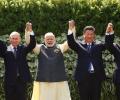
Narendra Modi's success at the BRICS summit is the best Diwali gift for India's diplomacy and marks her ascendancy to global leadership, says Tarun Vijay.

"On one hand, broadening and deepening our economic and commercial ties across a range of sectors is critical at this moment, for example in civilian nuclear cooperation. Strengthening our security partnership is also vital," Madeleine Albright said ahead of the fourth India-US Strategic Dialogue in New Delhi next week.

This is the joint statement issued by the ministry of external affairs on the visit of US President Barack Obama to India.

'We have a common way of looking at the world, a common way of thinking, and a common set of values that predispose us to be partners. And our interests overlap greatly,' Dr Ashton B Carter, America's next defence secretary, told Aziz Haniffa/Rediff.com in an exclusive interview.

'The men in black suits and hair dye in Beijing have not only completely blown the cover story of "peaceful rise," but have managed to antagonise regional powers in the Indo-Pacific.'

Vajpayee had always felt that India must act with conviction and panache. He decided that, irrespective of the attendant risks, he would undertake what many felt was a precarious course. A fascinating excerpt from N K Singh's Portraits Of Power: Half A Century Of Being At Ringside on Atalji's 96th birthday, December 25.
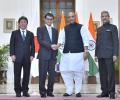
The India-Japan 2+2 dialogue added strategic heft to the special relationship in the wake of growing Chinese assertiveness on regional affairs, points out Dr Rajaram Panda.
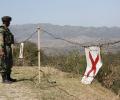
'The response to terror is not always reciprocal terror, nor is launching a conventional response the best response.' 'The best response is to make the sponsor pay a price he cannot afford,' says former RA&W chief Vikram Sood.
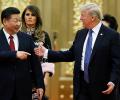
'What matters is that India's perspective on global issues -- climate change, intellectual property, free trade, trade routes being kept free, digital technology -- are listened to with respect,' says Ambassador B S Prakash.

Stating that India's entry into Nuclear Suppliers Group will "shake strategic balance in South Asia and even cast a cloud over peace and stability in the entire Asia-Pacific region", an article in the state-run 'Global Times' however said China could support India's inclusion in the 48 member nuclear club if it "played by rules".

Diplomats agree that amid stormy relations with China and Pakistan, Modi has posted impressive foreign policy successes, notes Aditi Phadnis.

India has built two top-secret facilities in Karnataka to enrich uranium in pursuit of its hydrogen bomb dream.
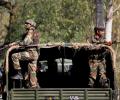
'More needs to be done in less time,' says Vivek Gumaste. 'A sense of urgency is crucial if the BJP wishes to fulfil its promise of tough, no-nonsense, governance in matters of security.'

'We rarely choose to fight when the threat is still a nascent threat. When we do fight, we fight when the invaders reach Panipat and are preparing to knock on the gates of Delhi.'

Even as the polity find ways and means to address the genuine concerns and fears of the society, the Sri Lankan State apparatus would have to unravel these mystery-questions with convincing answers, and a road-map to the future, says N Sathiya Moorthy.

It has been a half-century since Neil Armstrong stepped out of a lunar module and onto the surface of the moon on July 20, 1969 and declared, "That's one small step for [a] man, one giant leap for mankind." The moment heralded a golden age of space exploration that was set in motion just eight years earlier in 1961, when United States President John F Kennedy promised before Congress to put a man on the moon before the decade was out. Here are some lesser-known facts about the historic first mission:

'Previous governments in India had reservations about working with Israel.' 'Modi has shed this tag.' 'Disengaging itself from its traditional and ideological foreign policy approach in the Middle East shall serve India's long-term interests.' Rajaram Panda explains why the significance of Modi's visit to the Jewish nation goes beyond markers like the first-ever visit to Israel by an Indian PM and 25 years of diplomatic ties.

President Xi Jinping's visit may put relations between India and China on a new trajectory

'The question remains: Was the Obama visit truly a success? Only the future will tell us if the "breakthrough" in the nuclear liability issue will concretise into electricity.' 'As importantly, it will be interesting to watch how India's relations with China will evolve in the months to come.'

One thing Beijing must understand is that India is not obsessed with being a threat to China but only wants a rightful place for itself in the world, says Sanjeev Nayyar.

'The origins of the model of planned economic development adopted by independent India was a direct consequence of the war.' 'The war provided an opportunity for groups at the margins of Indian society to find new avenues for mobility.' 'The war also led to the emergence of India as a major Asian power and set the stage for it to play a wider role in international politics.'
 © 2026 Rediff.com - Advertise with us - Disclaimer - Privacy Policy - Sitemap - Feedback - About us - Terms of use - Grievances